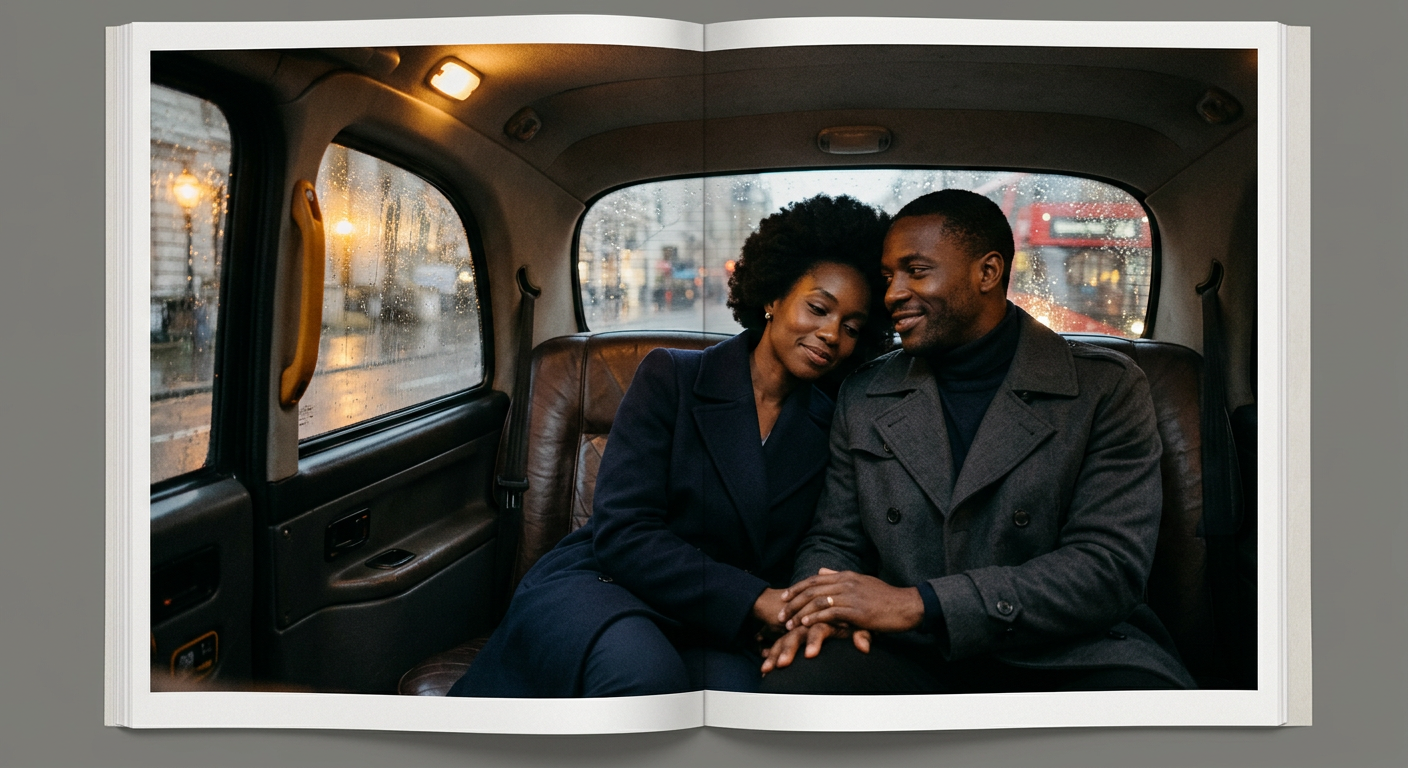
By the bottom of the second glass of wine in a low-lit corner of Marylebone, you have discovered that you both spent your childhood Decembers in East Legon, both own the same vinyl pressing of Expensive Shit, and both nurse an irrational contempt for people who order flat whites after two in the afternoon.
It feels like recognition. It feels as though the universe has bypassed its usual administrative delays and delivered someone who speaks your private dialect.
It is almost certainly irrelevant.
We have spent the last decade mistaking demographic clustering for romantic destiny. Because identity in London is so aggressively curated through consumption—the gallery memberships we hold, the natural wines we pretend to understand, the exact diaspora memes we dispatch to our siblings before breakfast—we assume an identical cultural consumption profile signals an aligned spirit. It does not. Taste is merely the wallpaper of a personality. Compatibility is the load-bearing masonry.
The aesthetic trap
Liking the same things is delightful for recreation. It makes booking a long weekend in Lisbon or securing a table at an impossibly loud restaurant in Shoreditch wonderfully frictionless. You do not have to negotiate the playlist in the rental car. You do not have to explain why you want to spend three hours in an independent bookshop in Brixton.
Recreation, however, is not governance. A marriage, or any partnership designed to survive the messy middle of adult life, is essentially a small sovereign territory. It requires an agreed policy on resource allocation, border control, foreign diplomacy (principally both sets of parents), and crisis response.
Nobody ever walked out of a ten-year partnership because one person preferred highlife and the other listened to dubstep. People walk out because when one partner feels cornered, they retreat into four days of punitive silence, while the other demands an immediate, forensic cross-examination before anyone is permitted to sleep.
Shared taste is recreation. Compatibility is governance.
You can find someone who matches your entire cultural moodboard—someone whose flat contains the exact same coffee-table books from the African Modernism exhibition, who knows every inflection of a Ghanaian auntie's greeting, who laughs at the exact same jokes about boarding school—and find yourself utterly miserable within six months. If their instinct during financial panic is secrecy and yours is aggressive confrontation, your identical taste in mid-century furniture will not save the Sunday afternoon.
Temperament versus territory
True compatibility is largely physiological and operational. It lives in the unglamorous mechanics of how two nervous systems interact when the pressure spikes.
Consider what happens when ordinary life collapses. You are stuck at Heathrow at nine on a sodden November evening; a flight to a family wedding in Kingston has been cancelled, the luggage has evaporated into the baggage system, and the airline representative possesses the emotional warmth of a wet kerb.
In that moment, it does not matter that you both own first editions of the same poetry collection. What matters is the architecture of your temperaments. Does one of you turn into an incandescent rage-machine while the other dissociates into a phone screen? Or do you instinctively move into a rhythm where one handles the rebooking logistics while the other secures the tea and quietly recalibrates the room's emotional temperature?
Real compatibility is complementary distress tolerance. It means knowing the answers to questions that never appear in a profile:
- How does this person behave when they feel small, embarrassed, or professionally exposed?
- What does their accountability sound like? Is it a defensive counter-attack, an agonised performance of guilt designed to make you comfort them, or a quiet, grounded apology?
- How much solitude do they require to remain civil, and can they take it without making you feel exiled?
- When their family makes an unreasonable demand on their time or their bank account, where does their spine land?
That last point carries particular weight across our communities. When a mother calls on a Sunday afternoon with an urgent expectation wrapped neatly in a prayer, or an uncle assumes your savings are an informal mutual fund, compatibility is not whether you both roll your eyes afterwards. Compatibility is whether you and your partner agree on where the perimeter of your household sits—and whether your partner will stand beside you at the threshold, holding the line without flinching.
The gift of different worlds
There is a stubborn, unspoken vanity among ambitious professionals that marrying someone with different interests represents an intellectual downgrade. We worry that if our partner does not share our obsession with private equity deal structures, architectural theory, or post-colonial African literature, we will end up intellectually marooned.
This is a failure of imagination.
A partner is not an echo chamber. Expecting one human being to be your intellectual sparring partner, your financial co-pilot, your co-parent, your social companion, and your aesthetic twin is not romantic ambition; it is an unmanageable burden laid upon someone you claim to love. The most durable partnerships often possess a healthy degree of aesthetic divergence.
He spends his Saturdays cycling eighty miles into the Surrey Hills in unflattering gear; she spends hers reading in a gallery in Dulwich. They meet at seven in the evening with actual stories to tell, rather than comparing notes on an experience they both just passively sat through together.
What they share is not the itinerary of their Saturday. What they share is a baseline standard for domestic peace, an identical instinct for hospitality, and the same fundamental generosity with each other's frailties after a punishing week in the city.
What to look for tonight
If you are currently evaluating someone new, stop listening for cultural and aesthetic echoes. Stop treating a mutual reverence for jollof rice or an identical taste in podcasts as proof of an aligned fate. It is very easy to be seduced by a mirror.
Instead, watch the engine.
Pay attention to how they speak about people who can do nothing for them. Notice what happens when you hold an opinion that directly contradicts their worldview—do they become curious, or do they become quietly condescending? Watch how they handle your exhaustion when you have nothing sparkling, brilliant, or charming left to offer across the table.
Look for a person whose pace of life does not make your pulse race with unease. Look for someone whose silence feels like resting rather than waiting for a storm.
You are not curating an exhibition of your good taste. You are choosing the person who will sit across from you at a kitchen table on ordinary, grey Tuesday mornings when the music has stopped playing.
Questions people ask
- Is it a red flag if my partner and I have completely different hobbies?
- No. Different hobbies often protect a relationship by giving both people private worlds to inhabit and return from. Compatibility is not doing everything together; it is whether you can grant each other space without resentment and agree entirely on the bigger architecture: how money is managed, how family boundaries are held, and how disagreements are resolved.
- Why do people with identical cultural backgrounds still fail at compatibility?
- Shared cultural background offers shorthand, not character alignment. You may share the same food, church traditions, and familial expectations, but differ entirely on financial transparency, conflict styles, and emotional regulation. Cultural familiarity can create a false sense of security that blinds you to fundamental differences in temperament and values.
- How can I assess temperament compatibility in the first few dates?
- Watch how they react when minor plans fall apart—a lost reservation, a delayed train, or a misunderstanding with a waiter. Notice whether they seek someone to blame or quietly pivot to a solution. Pay close attention to whether they can sit comfortably in quiet moments without rushing to fill the silence with performance.