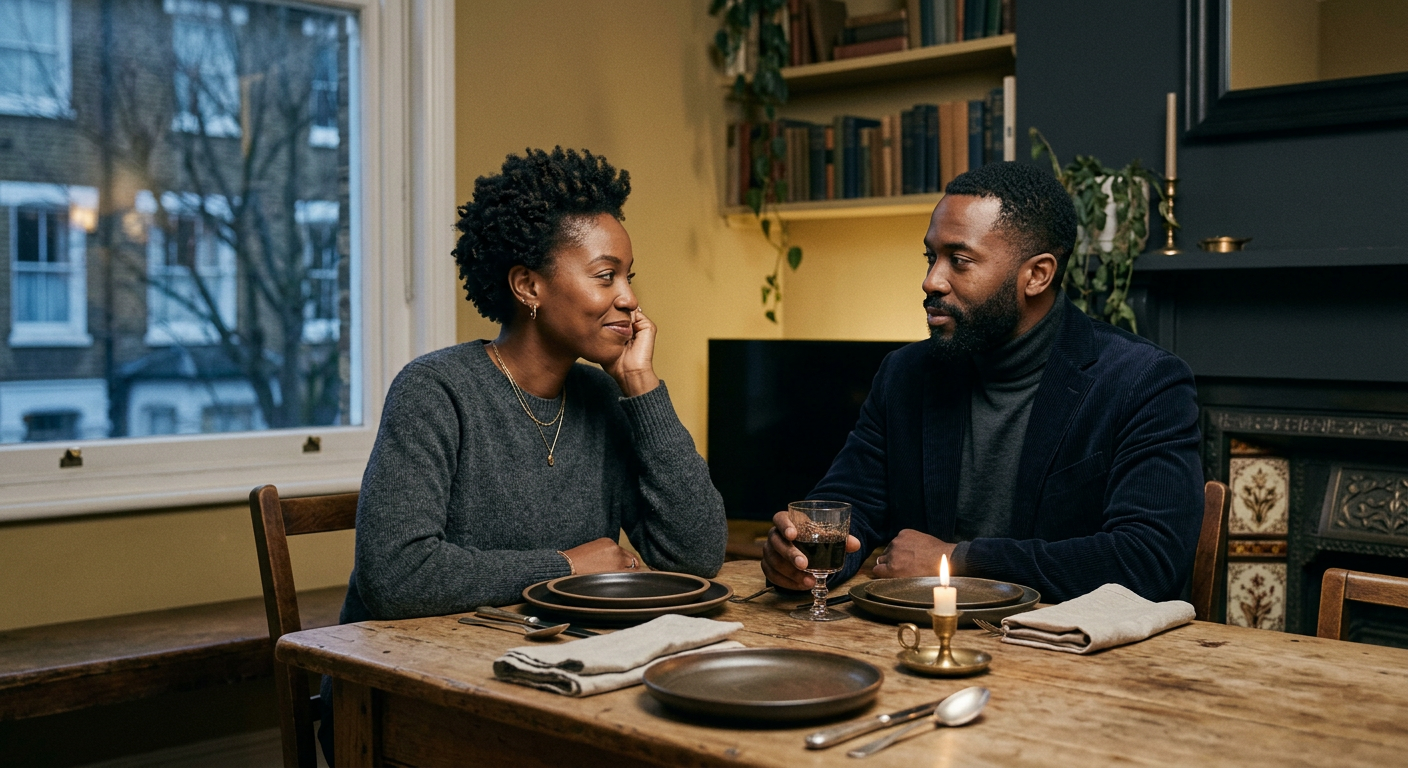
By the arrival of the second course at a corner table off Marylebone High Street, a Nigerian man has already decided where this is going and laid his working timeline on the table. The Ghanaian woman opposite him has spent those same forty-five minutes deciding whether his voice is half an octave too loud for the room.
London has spent forty years collapsing West African professionals into a single, high-achieving demographic. You went to the same redbrick or Russell Group universities, you share the same exhausted exasperation with the Black Hair aisle in Boots, your parents attend different branches of the same Pentecostal churches in south-east London, and you both clear your calendars for two weeks in December. On paper, the shorthand holds. In practice, put a Lagosian romantic instinct and an Accra romantic instinct into a private room, and the fault lines appear before the bill arrives.
The divide is not culinary. It is about tempo, public theatre, and entirely contradictory definitions of respect.
The Velocity of Intent
Nigerian courtship, across both Yoruba and Igbo traditions, operates on clarity, speed, and active momentum. There is a velocity to Nigerian romantic interest that is often misread by outsiders as impatience or entitlement, but it is rooted in an old domestic ethic: if I am serious about you, leaving you in ambiguity is bad manners. Ambition is not kept in reserve; it is brought to the table early as proof of good faith.
To be courted with Nigerian intent in London is to experience romance as an active, organised campaign. The invitations are decisive. The calendar is managed with purpose. By the fourth date, a Nigerian professional is rarely wondering where this is heading; they are operating on the quiet presumption that you have both recognised the mutual advantage of being together.
Ghanaian courtship moves to a markedly different metronome. In Ghanaian culture—particularly among Akan and Ga lineages—pacing is a moral virtue. High-velocity assertion is not read as confidence; it is read as slightly unrefined, performative, and almost certainly insincere.
Where the Nigerian instinct leads with declaration, the Ghanaian instinct leads with steady observation. A Ghanaian man or woman will spend three months assessing your temperament, your speech, how you speak to a waiter in Mayfair, and how you manage disagreement before offering a single conclusive sentence about the future. They are gathering intelligence with a warm, polite restraint that can feel, to someone raised on Nigerian directness, like cold feet or deliberate indifference.
The Nigerian partner wonders why everything feels like an audition with no feedback; the Ghanaian partner wonders why the curtains are being measured before the foundation is dry.
This is where early dates between the two cultures stall. The Nigerian reads Ghanaian discretion as emotional cowardice or lack of passion. The Ghanaian reads Nigerian decisiveness as theatrical pressure, wondering why someone who has known them for four weeks is already discussing property in Surrey.
The Social Theatre of Discretion
Then comes the dispute over who is allowed to know.
In the Nigerian diaspora, romance is social almost from its inception. Even in early stages, bringing someone into the fold—having them sit at your table at a wedding in Woolwich, introducing them to a cousin who works in the City—is the primary mechanism for signalling respect. Visibility is proof of honour. If a Nigerian partner keeps you tucked away in their flat in Bermondsey for six months without introducing you to their people, the working assumption is that they are wasting your time or hiding another life.
For Ghanaians, discretion is the hallmark of pedigree. Nsem pii—too much noise, too much exposure, too much public chatter—is treated as a failure of character. A Ghanaian professional will date someone for half a year without putting a single trace of it on Instagram or mentioning the development to their wider circle. This is not evasiveness; it is protective custody. To the Ghanaian mind, premature visibility invites unnecessary scrutiny, unsolicited opinions, and spiritual noise.
To the Ghanaian, keeping a relationship quiet protects its dignity. To the Nigerian, keeping a relationship quiet denies its existence.
When a Nigerian woman asks her Ghanaian partner why his siblings have not heard her name after four months, she is asking whether he has any honour. When he recoils at the demand, he is defending his sense of decorum. Both are attempting to protect the union, but one uses a spotlight and the other uses a vault.
How the Family Enters the Room
When courtship approaches commitment, the architecture of family involvement diverges entirely.
Nigerian family scrutiny is vertical and structural. Families want to establish pedigree quickly: who are their parents, where did they study, what is their standing, and what do they bring? Once those markers are satisfied, the logistical machinery engages. The introduction is an event; the traditional wedding is an announcement to the world that two substantial houses have completed a successful merger.
Ghanaian scrutiny is horizontal, quiet, and obsessively concerned with temperamental harmony. It functions by social osmosis—an aunt who discreetly consults a colleague at the hospital, a mother who listens to the tone of voice you use when you are tired. The central question is rarely just about career or lineage. It is: does this person know how to live peacefully with others?
A Nigerian introduction is an arrival; a Ghanaian introduction is a confirmation of propriety.
Dropping the Regional Prejudices
Both cultures carry romantic flaws they prefer not to name. Nigerian diaspora dating often mistakes volume for depth, treating aggressive decisiveness as a substitute for genuine emotional attunement. Ghanaian diaspora dating often weaponises "discretion" as an excuse for emotional passivity, hiding behind manners to avoid ever making a clear choice.
If you are dating a Ghanaian, stop waiting for a theatrical speech. Their consistency is their declaration. Notice whether they remember how you take your tea, whether they show up precisely when they promised, and whether they make quiet, unannounced adjustments to their life to accommodate yours. That is their language of devotion.
If you are dating a Nigerian, stop punishing them for their speed. Their certainty is an offering, a statement that they consider your time too valuable to waste on coy games. You do not have to move at their pace, but you should recognise the courage behind their clarity.
Diaspora romance fails when two people expect their heritage to do the heavy lifting of intimacy for them. You can both love the same highlife tracks, both attend the same watchnight services, and both buy your plantain from the same stall in Brixton. But until you learn how the family across from you was taught to signal commitment, you are simply two people speaking English, completely lost in translation.
Questions people ask
- Why do Nigerian and Ghanaian dating styles often clash in London?
- The friction usually stems from differing tempos and expectations around privacy. Nigerian courtship tends to be direct, rapid, and publicly visible as a sign of respect and serious intent. Ghanaian courtship prizes emotional restraint, observation, and deep discretion. When dating, a Nigerian partner may view Ghanaian reserve as lukewarm interest, while a Ghanaian partner may see Nigerian directness as performative or rushed.
- How do Ghanaians typically demonstrate serious romantic interest?
- Ghanaians show commitment through sustained reliability and quiet consistency rather than grand early declarations. Discretion is valued, so integration into their life happens deliberately, usually beginning with trusted friends before wider family. Steady punctuality, attentiveness to character, and emotional calm are their primary markers of intent.
- What is the biggest mistake couples make in cross-cultural West African relationships?
- Assuming that shared religious faith, professional drive, or general West African background means identical domestic expectations. Pacing, conflict resolution, privacy norms, and family dynamics vary significantly between Accra and Lagos lineages. Successful relationships require learning the specific subtext of your partner's household rather than assuming cultural uniformity.